).
).Moving an aircraft to the N (USA) registration
This article was originally written in 2005 and updated since.
Why Transfer to N?
The main reason is to be able to use the FAA Instrument Rating. And, to obtain worldwide privileges of a Rating, it is (in general) necessary for the country that issued the Rating to be the same as the country in which the aircraft is registered.
Other reasons include a much more sensible approach to maintenance than European (EASA) registers offer - see details below.
Trust Ownership
US-registered aircraft must be owned by a US citizen, or a US corporation (with a minimum US shareholding requirement) or a US based Trust (which must own at least 75% of the aircraft). This is a legitimate device and countless thousands of N-reg aircraft around the world are owned by such trusts. Many are based in Delaware. The trust charges for the service, of course, and the charges vary widely according to the sort of market the outfit is going after. There are a number of trusts with UK offices that are reasonably priced, around a few hundred pounds a year, and some that go after the bizjet market and charge accordingly more. I went with Southern Aircraft who have been recommended by a number of other N-reg owners and whose pricing is very good.
In 2012, some people have been spreading FUD (fear, uncertainty, doubt) about the willingness of the USA to continue allowing the use of the traditional trusts for N-reg operation. The FAA has held a consultation (URL, local copy) in 2012 and this has come out positive and encouraging. The FAA doesn't like trusts which conceal the trustor's (the beneficial owner's) identity and it doesn't like "side deals" like pre-signed bills of sale and other devices which enable the trustor to cancel the trust unilaterally, too easily.
Benefits and Drawbacks of N-reg (Part 91 operation assumed; listed not in any order of importance)
Benefits:
a) A pilot with the FAA IR gets worldwide FAA IR privileges. This is the #1 reason private pilots do it, in most cases. From April 2016, for owner-pilots living in the EU, this will probably disappear (see notes at the end).
b) No Insurance Premium Tax (saves 5% on the premium)
c) Easier installation of modifications. The approval route (337, DER, etc) may not be cheap (especially via a UK avionics shop) but the process is usually straightforward. In theory one can obtain UK CAA/EASA approval for anything on an EASA-reg but the process can be very expensive for even small mods and is completely uneconomical in many cases.
d) Can fit STCd aftermarket accessories which are already approved in the USA but aren't not Europe (EASA) approved e.g. much better landing lights. Can also fit FAA-PMA parts. Update 11/2015: EASA is accepting FAA-PMA parts - here subject to some restrictions - local copy
e) Pilot maintenance is permitted, to an extent which is slightly superior to the EASA Part M regime.
e2) For EASA-reg aircraft, there is currently a CAA/EASA requirement to comply with all ADs that apply to the aircraft regardless of the country of the AD issue. So if you have a G-reg it has to comply with ADs from the FAA that affect it or any components on it, whereas an N-reg aircraft (Part 91) needs to comply only with FAA ADs even if it contains parts that are subject to an EASA AD. The degree to which this saves costs is variable but it is a good thing given the past tendency of for example the UK CAA to generate large numbers of ADs which every other country thinks are pointless. There are few if any important EASA ADs which are not also FAA ADs. The reference for this requirement is currently in CAA CAP411 5.1 All applicable Airworthiness Directives issued by EASA, the CAA and any applicable Third Country Airworthiness Authority which is responsible for the state of design must be complied with.
f) In some situations, reclaim of duty on parts is possible with an End User Certificate. This is however possible to achieve anyway using a Form C100 - more details here (local copy).
g) The CAA Notice 75 propeller inspection, generally regarded as causing more problems than it prevents, is not required. Update 10/2007: Notice 75 has been replaced by CAP747 Generic Requirement 17. Mostly the 3 year/6 year cycle has been replaced by overhaul in accordance with manufacturers recomendations, normally 6 years or 2000hrs.
h) Can freely buy parts (new and overhauled) from the USA. This can be a major cost benefit of N-reg. An 8130-3 form is desirable but not mandatory; the regulations are in FAA Order 8130.21. Some notes on required documentation are here. An 8130-3 is OK for a G-reg aircraft but only if the part is new. Overhauled or used parts with an 8130-3 cannot be fitted to a G-reg; they need an EASA Form 1 which can be generated only by an EASA 145 company and this usually increases the cost substantially. 4/2011: it is widely claimed (and believed) that EASA regs mandate an EASA-1 form for absolutely everything, which is false and if true would be a ludicrous cost inflater.
i) If an SB (Service Bulletin) becomes an AD (Airworthiness Directive) then it becomes mandatory and must be implemented. The majority of ADs track between CAA/EASA and the FAA but there are still CAA ADs which the FAA has not mandated. Given that around 75% of the world's General Aviation is in the USA, this appears pointless regulation. However, the FAA is gradually implementing a process whereby mandatory SBs on European-manufactured aircraft are automatically converted into FAA ADs and thus the work must be done on such an aircraft even if it is N-reg - additional info here. This applies to future EASA MSBs only; it is not retrospective.
j) The USA has filed some differences to ICAO on the medical front and has not imposed the audiogram requirement (reference here) which is required for an EASA CPL/ATPL or a JAA PPL/IR (it is not required for a plain JAA PPL). This unreasonable requirement means that a pilot with one perfect ear and one ear which doesn't meet the specification (a common enough condition especially among older people) cannot ever get an EASA IR - even though the headsets are monaural so one bad ear doesn't matter. EASA permits "demonstrated ability" but only on a renewal medical - this is ironic since all airline pilots who are actually working are flying on renewal medicals!. 12/2010: there is some hope here that this may change.
k) In some situations where an aircraft is "rented out" but not to just anybody who turns up (e.g. an individual owns a business which owns the aircraft, and the aircraft is rented back to the individual; this is a common procedure done under the UK Inland Revenue Benefit in Kind rules) an N-reg aircraft is legal if maintained under Part 91 rules, whereas a G-reg aircraft thus operated would arguably need to be maintained to a Public Transport CofA regime, and that is significantly more expensive (50hr checks, 150hr checks, all done by an EASA145 company, plus a lot of pointless maintenance) and is pointless given that the actual operation is identical to a fully privately operated aircraft flown by the very same pilot.
l) It is often easier to find good freelance maintenance engineers (FAA A&Ps) to work on N-reg aircraft than on EASA-reg (EASA66, plus a separate EASA Part M signoff). This means you can assemble a group of good people who you can trust. For the Annual you may still have to go to a large-ish firm (because of the amount of work involved, and the need for a hangar in which work is permitted by the hangar owner) not many freelance engineers can do Annuals) but for everything else you can make sure that the job is done properly, preferably with you present and helping out. With an EASA-reg, you practically speaking have to use a company and the problem with using a company is that it is impossible to attribute bad workmanship to a particular individual. This makes it easier to avoid the numerous crooked maintenance companies; one of many EASA Part M scams is pretending that the first Annual the company does on a particular aircraft needs a "back to birth" inspection of everything...
l2) When on a long trip away from Europe, it is much easier to get maintenance on an N-reg aircraft than on an EASA-reg aircraft. There was a case where the Annual on a G-reg expired while passing through Australia. The UK CAA refused to accept Australian maintenance and insisted on a CAA inspector to fly out there (first class) to do it. It was cheaper to transfer the aircraft to N-reg and fly it back that way, which is what was done...
m) There is no UK CAA 150-hour service. For G-reg pilots who do more than 150 hours per year, this is a major added cost as the 150 hour check costs almost as much as the full Annual.
n) There is a relatively straightforward regime for owner produced parts. This is particularly relevant for aircraft types where the original manufacturer is no longer producing the parts. In short, he owner can make the part, for his own aircraft only. However, this is not a free-for-all for making one's own bits; the part's manufacture and installation still requires to be documented and is likely to be queried by a subsequent buyer. URL local copy
o) The US aircraft market is much bigger than the European one, especially for more advanced types which are much more ubiquitious out there due to the much more accessible IR. This makes an aircraft import from the USA attractive, but transferring the N-reg aircraft to a European reg can be problematic.
p) Most of what EASA regards as life-limited parts, for no technical/engineering reason, can be operated "on condition" under FAA Part 91. On an N-reg, the only strictly life-limited items are ones listed as such in the Airworthiness section of the POH.
Drawbacks:
a) For full worldwide privileges, the pilot needs an FAA License. One can fly an N-reg on a UK/JAA license but only within the UK (not the Channel Islands). In fact any ICAO license is OK but FAR 61.3 limits its use to the airspace of the country that issued it. Whether the UK NPPL is OK is a good question; similarly there has been some doubt over whether the UK IMC Rating is valid or whether a UK/JAA PPL with a night qualification can be used to fly an N-reg at night in the UK; more info here.
a1) While FAR 61.3 allows an N-reg to be flown outside the USA on any foreign license provided that license has been issued by the owner of the airspace concerned, the airspace owner is able to disallow this. I have a confirmation (1/2008) that Belgium does this, and requires any N-reg flown in its airspace to be flown under either an FAA license, or a FAA validation of a Belgian license (no indication this is enforced). There may be other instances of this. However, 61.3 is not a useful concession since most pilots only have one license and thus the aircraft cannot leave the one country...
b) There was a question mark over the ability to rent out an N-reg aircraft, and common rumour has been that a Dry Lease is required if one does so. The legislation (FAA and UK) is silent on this subject, and extensive enquiries have not found anything supporting the Dry Lease requirement. On 1st March 2005, Roger Kinsey at the DfT confirmed to me that renting is OK provided the renters don't do any aerial work in it. The DfT will not (officially) give permission to anyone who has rented an N-reg aircraft, even for any form of training and that includes a BFR (unless the instructor does it for free - see the link in g) below) but in practice they are quite helpful, so it's always a good idea to ask them. So anyone renting an N-reg aircraft (UK airspace) needs to already be legal to be PIC in the type. More details here.
c) Cannot do PPL Cost Sharing. Even though the FAA does have such a scheme,
it cannot be operated in UK airspace on a foreign registered aircraft as this
would breach 2005 ANO Article XXX (renumbered a few times; it's the one governing
aerial work in foreign reg aircraft). Passengers are not permitted to make any
contribution to costs in UK airspace. There is also the theoretical possibility
that a payment from a passenger on a flight which took place wholly within a
country where the aircraft is not registered could be regarded as cabotage.
I carry a letter from a senior French Customs official assuring that cabotage
will not be applied to private flights, but there is the possibility that they
might not regard such as a "private" flight to start with. The safest
thing is for the pilot to not accept any money from passengers, in an N-reg
flying in Europe, and make this very clear before the flight (before witnesses,
if the passengers are not known to the pilot ).
c2) For pilots flying N-reg on US licenses, the FAA Common Purpose rule - discussion and references - makes many cost shared flights illegal.
d) Document checks: U.S. registered aeroplanes are provocative to people who do not like U.S. foreign policy and while the European aviation world is nearly universally professional there are sporadic exceptions where Customs/Police officials do targeted document checks, so documents must be carried on board and be in order. In particular, they look for a document showing EU VAT has been paid on the aircraft, and for the pilot's IR if he arrived via an IFR flight plan / instrument approach. These checks have been reported in France and Germany in particular. It would probably be unwise to take a flying holiday around [insert name of any currently unstable country in the Middle East] of course... Also, each pilot flying under the privileges of an FAA license, outside U.S. airspace, needs to have his own radio license; details in the Documents link above.
e) All work on an N-reg aircraft must be done by an A&P or under A&P supervision. The Annual must be inspected and signed by an A&P/IA or under the authority of an FAA Part 145 company whose FAA approval specifically includes your aircraft type. While most European maintenance shops do maintenance on N-reg aircraft, few of them are Part 145. So they do the work "under FAA A&P supervision" and then (for an Annual) they get an FAA A&P/IA to come in and sign off the Annual. You still need an FAA 145 Repair Station for the 2-yearly static check and for this you may have to get someone to travel who charges substantial hourly and travelling fees. This can increase costs. Another trap is if e.g. you get your engine overhauled by an engine builder who has no FAA capability (no A&P involved, no FAA Part 145) that engine cannot be installed on an N-reg (this has sometimes been ignored).
e2) For Major Alterations, the common US system for field approvals, whereby a 337 is filled in by an IA and sent off to the local FSDO for approval, is not available to European N-reg owners. The only FSDO officially available for Europe is the NY IFO and they have stopped doing this work several years ago. The only remaining "official" option is to get a DER to generate an 8110-3 form which is then sent with a 337 to the FAA in Oklahoma for filing (they cannot, in general, refuse it) and this route (popular with European avionics shops) can add quite a bit of money and effort. However, a lot of installations can be done as Minor Alterations, using e.g. the Installation Manual as the Approved Data - it is up to the IA to determine if there is enough Approved Data. It is however also possible to process a 337 + Approved Data conventionally via a normal US FSDO, if you can find a co-operative one, as described here.
f) Prices charged to N-reg owners are more likely to get inflated than to EASA-reg owners. This is probably because N-reg planes tend to be owned by the pilot and so they get looked after better than the average EASA-reg self fly hire machine. A quick look around any European GA airfield shows the generally higher standard of N-reg aircraft over locally registered aircraft. It pays to get educated on how much something should cost before getting work done. Also some avionics installers operate a revenue generating scheme where they claim they need a DER design package for simple mechanical work which is normally done in accordance with AC43-13...
g) In the UK, any Aerial Work (which includes instruction or BFRs, if the instructor is being paid for it) requires permission from the UK CAA. More details here.
h) The trust requires you to sign the aircraft over to somebody that you have to trust and in theory they could just run off with it. I am not a lawyer but apparently this is very difficult for them to do (because the trust document obliges the legal owner to allow the beneficial owner to do more or less whatever he likes) and some also have insurance to cover various things. I have checked with one of the UK's largest aviation insurance firms and it is not possible for the beneficial owner to insure against a breach of the trust. They were unconcerned about it however, stating that one can get more problems if the US citizen that runs the trust dies. It's worth checking with him what provisions have been made for such cases. Update 2010: this has actually happened; the owner of Southern Aircraft Consultancy, Warren Chmura, did die in a motoring accident, but his brother (also a US citizen) took over immediately - just as he said would happen when I put the question to him years earlier.
i) If flying under a standalone FAA license, the pilot needs the FAA Class 3 medical as a minimum. The FAA Class 3 has stirred up some controversy, perhaps because it doesn't include an ECG. However The FAA Class 2 doesn't have an ECG either, below a certain age. ICAO does permit a national authority to impose its own medical requirements on resident pilots; this is rarely invoked but in 2004 the Irish CAA has reportedly taken advantage of this and refused to accept the FAA Class 3 for Ireland-based N-reg pilots. For some reason a FAA Class 2 is a lot cheaper than the CAA Class 2. For me, £60-80 (year 2010) against £150 for the CAA Class 2, both being very similar and done within 2 weeks of each other, and the FAA one was slightly more stringent (for me) on the eyesight. The FAA Class 3 is valid for an extra year but I reckon that one may as well go for the FAA Class 2, to avoid any potential for future trouble. Personally I hold an FAA Class 1 medical, simply because I can, fortunately...
j) An ELT is mandatory. The FAA tried to mandate 121.50+406MHz ELTs but failed, so strictly speaking an N-reg needs to carry only an old 121.50 ELT. A 121.50+406MHz ELT is much more sensible... The installation can be expensive especially if extra metalwork is required. Update 5/2010: many/most European CAAs have mandated 406MHz and this applies to all aircraft flying in their airspace regardless of registration. I don't know the EASA position which will eventually take over.
k) The FAA will not accept some modifications that the CAA (now EASA) will accept (and vice versa). The FAA is fussy in some departments; for example a TB20 aircraft with full TKS is certified for flight in icing on a G-reg but not on the N-reg - this is because the FAA requires two alternators and other items.
l) There are sporadic instances of non-EU aircraft requiring longer
PPR notifications e.g. 24hrs instead of 3hrs, or being charged more. This has
been noticed in Greece but there are likely many others. Entry into Turkey needs
24hr prior notice from the Turkish CAA (confirmed 2007). It is always worth
faxing the destination airport regarding PPR requirements, giving the N- tail
number clearly so they can see in advance it is US registered, in case they
are different to the published ones. I reckon that some of the issues I have
come across with PPR might well be the result of prejudice against U.S. aircraft
and this has been cited as a prime reason why owners of business jets are looking
at the Isle of Man (M-reg) register. 5/2012: Greek airports charge €1.63/day
for parking aircraft of EU registry and €7.34/day for aircraft of non EU
registry
m) The recent American TSA regulations have caused havoc with FAA training. A useful summary is here and here and it's worth noting that the TSA applies even to certain classes of FAA instruction (mainly PPL and IR) outside the USA! The Visa situation is more of a grey area but it is most likely needed for a PPL or an IR. Getting FAA training in the UK is not much of a problem but getting checkrides organised in the UK is difficult. More details are in this article. 6/2016: it is no longer possible to sit FAA exams outside the USA - details here.
n) In the USA, FAR 91.175 prohibits an instrument approach other than using an official instrument approach procedure (IAP), and this possibly applies to N-reg aircraft worldwide. More details here.
o) Going back to G-reg can be problematic. Think about this carefully! There are cases where an aircraft with certain certification issues can exist on a G-reg, but it could not be placed on G-reg today. Of course they have to get a CofA every so often (or the EASA equivalent these days) but that is not the same as an initial CofA, which involves an inspector crawling all over the aircraft and checking that every non-original item (well, every item he can spot) has acceptable documentation. If you go to N-reg and then want to go back, you might get caught by this - even if you have not done any mods. The EASA 12-year engine life issue is one recent issue. However, the whole EASA business (Part M specifically) is in a state of flux and nobody knows what will happen. There is also the more general problem (see h) under Benefits above) that a part can be fitted to an N-reg purely on the basis of an STC or PMA approval, signed off by an IA, but such an aircraft cannot go back on G-reg unless the part came with additional documentation; more details here.
p) While a US based owner can choose which U.S. mainland FSDO he uses to approve a modification, non-US owners have to go via the NY IFU, but the NY IFU stopped processing avionics 337s around 2010. There are ways around this, by using a DER to generate approved data which is then submitted via a different process, but this is a lot more expensive. Alternatively you can use a friend in the USA to present the 337 on your behalf to his local FSDO; some details are here.
q) Denmark has some curious regs banning the basing of foreign reg planes there, particularly by Danish residents URL local copy Google translation. There are reports of fines being imposed (around £300) but it does not appear the legality of this policy has been tested properly. It is obviously very difficult to frame legislation which imposes a long term parking time limit, so any practical implementaton is bound to be ad hoc.
r) Norway has a similar law to Denmark, prohibiting long term operations of N-regs there. A EuroGA discussion is here.
s) In 2012, the EU has finally passed into law some ludicrously vague proposals requiring all pilots to have EASA licenses/ratings regardless of aircraft registration, if the "operator" is EU based. More links are at the end of this article. Some countries have opted for a 2 year delay (eventually extended to April 2016 and later to April 2017) but, for IFR, this will eventually cause a significant increase in the effort to reach IFR capability and will reduce the incentive to own an N-reg aircraft to cases where the more reasonable certification regime (unusual equipment, mods, etc) is sufficiently relevant. Some info here.
Benefits and Drawbacks Summary
For most private pilots and given an aircraft that can be registered under G or is already, there is no significant benefit in the N registration, particularly given the cost of the transfer (see more details below). The most pressing reason is likely to be the FAA IR. Other reasons might be the wish to fit certain items (typically avionics) for which obtaining EASA approval is unrealistic, or the wish to purchase an aircraft (from e.g. the USA) with such items already fitted. In a few cases it can be medical issues related to the JAA IR which is probably the JAA audiogram requirement.
I also think that there is very little difference in the cost of scheduled maintenance - if you do the stuff that is actually important for safety and long airframe life. The major cost savings come from the ready use of FAA STCs, and - given the EASA Part M regime now running in Europe - from the ability to use freelance FAA A&P/IA engineers.
Transfer to N-reg
Obviously if you buy (or import) an N-reg plane then you don't have to do a transfer. Just leave it on the N register but unless you are a U.S. citizen you will need to transfer the ownership to a Trust, or to a U.S. citizen who you can trust to not run off with it :)
In my case, the aircraft was transferred to N-reg during an Annual inspection. This is the best time to do it because it saves the £600 (approx) CAA fee for the tri-annual (Star) CofA. The Annual was also done earlier (in February even though it wasn't due till May) because for a non-de-iced aircraft February normally has the worst weather.
The transfer process consists of
1. Reserving a suitable FAA registration
The FAA website is here (start with Interactive Aircraft Inquiry) and a registration costs $10 which you pay with a credit card.
Personal preferences aside, it's advisable to pick a number which is very quick to pronounce without twisting your tongue, and whose digits are distinct and will be easily understood by foreign ATC personnel. Most of the really nice (or short) numbers have been taken.
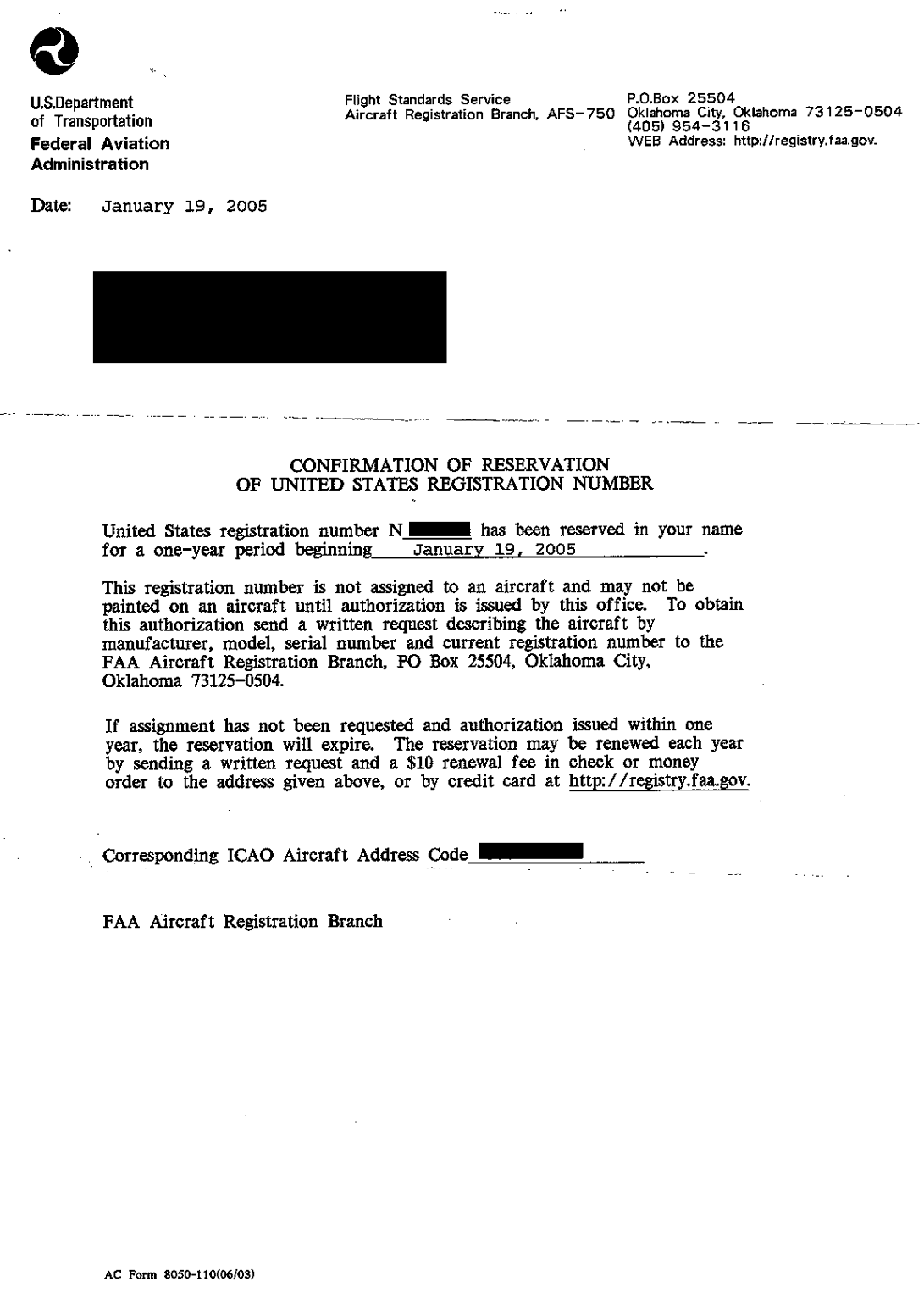
A couple of weeks later you get a letter like this from the FAA confirming the number has been reserved for one year. It also gives the Mode S aircraft code which you show the avionics installer when he puts in the Mode S transponder. This number will be programmed into the transponder and will identify your aircraft uniquely, worldwide!
2. Make sure all documents are in order
This is absolutely vital and it must be done while the aircraft is still legal to fly on its old registration! Otherwise, you can get stuck with a grounded aircraft which is in a legal no-mans-land and which may not even be able to go back on G-reg if it contains certain issues.
The obvious thing to check is that all work that's been done is recorded in the logbooks. It is OK for it to be recorded in work sheets which are then referenced in the logbooks. If the aircraft has had any modifications these are likely to require a 337 approval. It is important to identify any such items and consult with the FAA IA engineer who will be involved and make sure he is happy with them, or he can issue a 337 that covers them. Otherwise, they will have to come out! The old G-reg practice of sticking an INOP sticker over something is not sufficient.
Increasingly nowadays, the FAA is unwilling to accept modifications that were done under a CAA approval, so a CAA approval for e.g. a GPS antenna is likely to be insufficient. In my case, a lot of paperwork irregularities were discovered and I had to go back to the original firm who did the work and get them to produce additional logbook entries. This is an area where 10 different people will give 10 different answers but it is the view of the particular IA that matters, and then the DAR after him at the very end.
There is no substitute for using a firm that's done this before, and done it on the particular aircraft type.
7/2015: I found this interesting article on the internet. It is written by a DAR based in Europe. I hear plenty of evidence that going N-reg is getting harder, but this could simply be that an increasing number of EASA-reg owners are wishing to avoid their maintenance regime, have read on the internet that N-reg is "easy", and the result is a stream of aircraft in poor condition trying to go N-reg!
3. Applying any modifications that are easier/cheaper under EASA
There may be quite a few of these, not because EASA is cheaper but because most UK aircraft maintenance organisations don't have the FAA approvals and have to pay somebody who is FAA approved to sign off the job, or do some of the work. Some firms have FAA approvals for some types of work, or some aircraft types, only, so check beforehand that their approval covers the work and, if not, how they are getting the paperwork straight.
4. Deregistering from the CAA
This involves writing on the back of the existing G-reg Certificate of Registration that the aircraft is being transferred to the USA and sending it to the CAA. Within about a week they send through a certificate of de-registration. This particular aircraft happens to be owned by a UK limited company and curiously the new owner is written on the form as the same limited company (i.e. no change) even though the legal owner is the U.S Trust.
The CAA do this commendably quickly and if you phone them up (0207 453 6666) and ask nicely they will fax you the certificate of deregistration so the rest of the process can continue.
5. Applying any FAA modifications that can be done with the aircraft registration in limbo
The main one is probably the ELT installation.
An ELT is mandatory for FAA, reference. These are made by various firms e.g. Artex and Kannad. All emit on 121.50MHz; the old ones also emit on 243MHz and the latest tri-band ones emit on 121.50MHz, 243MHz and 406MHz. To be legal one needs just the first one or two but to be practically useful one needs a 121.50+406MHz ELT. A good reference for ELTs is Sartech. According to Artex, most ELTs are installed under a 337 field approval, not under an STC. Like most parts for an N-reg aircraft, you will need to get an 8130-3 form from the supplier of the ELT to be able to install it although a minor item (not an engine) without an 8130-3 can still be installed if the IA writes out a 337.
Like a kitchen/bathroom fitter, an avionics fitter buys goods at a discount from whatever "list price" you get quoted, so he prefers to do a "supply and fit" job. The trade discount then supplements his installation charge and usually the result is a lower total installation cost. So it's best to get them to supply the hardware. Most UK avionics shops do not like installing customer-supplied items anyway. However, having a friendly avionics installer who will accept customer-supplied parts is a gods-send because one can then buy very attractively priced items from U.S. avionics dealers with an 8130-3 form and free issue them to the installer.
There are antenna issues. Below a certain speed, about 160kt IAS, one can use a whip antenna which is a lot cheaper then the rigid type. The antenna should come with the ELT as a kit. A reinforcing plate is likely to be required to be riveted to the inside of the airframe, which is yet more paperwork for the "structural modification"...
The older/cheaper ELT types do not emit 406MHz and the installation may become a dead-end because the 243MHz network is being phased out by 2009 (references here). Some time after I went through this process, Artex introduced a unit called ME-406 which is a lot more compact, as well as a lot cheaper, than the traditional tri-band ELTs. Kannad do a very similar one, which in the Socata TB20 can utilise the existing Artex ELT-200 wiring and mounting points and this saves a lot of labour cost - details here.
If an ELT needs a mounting bracket (and is heavier than any ELT previously certified in that position) and a wiring modification it may require two signoffs (structural, and wiring) from a DER which can cost as much as £1000, on top of the cost of fabricating the metalwork.
6. Registering with the FAA
One has to wait for the FAA to generate the certificate of registration. This document is sent by the FAA to the administrator of the Trust, who then gives it to you and you need to show it to the FAA DAR. The DAR can in fact check its validity on the FAA website; just as well since the postcard-sized original takes some weeks to turn up in the mail.
In my case there was a further delay because Socata has allocated an N number to the aircraft when they originally built it - I knew about this and told everybody but somehow this bit of info got lost on the way. The FAA, noticing that an N number had already been attached to that serial number threw out the first application and it took a fax or two to get things moving again.
The Trust company I used, Southern Aircraft, dealt with everything promptly.
This document (local copy) details the FAA requirements.
7. Getting the aircraft FAA certified (FAA CofA issue)
This involves a visit from two people: an FAA IA and an FAA DAR who will both inspect the aircraft in turn. The IA charges a few hundred pounds, and the DAR (there are only a few of them in Europe) charges about £1300. I am not clear about their precise functions.
The FAA DAR will be fussy regarding documentation and it is the IA's job to make sure everything is right. In some cases a CAA Export CofA will be required; this is another £700 or so of which slightly over £500 is the CAA fee; I was able to avoid this with a letter from the French DGAC certifying that the aircraft met FAA requirements when it was manufactured, and with a complete maintenance history since then. It is essential that everything that's been done to the aircraft is written up in the airframe/engine/prop logbooks or, if (like most major work) it doesn't fit in the logbook, is written up in a works order and that works order is referenced in the appropriate logbook. If you have the works order sheets but the maintenance shop forgot to do the logbook entry, they are in breach of the regs but you have a problem; you can either send them the logbook and get them to write the entry in, or get them to send you a logbook insert which you glue in.
The full detailed maintenance records are legally a part of the aircraft logbooks (airframe, engine, prop as appropriate) and this is true for both the CAA and the FAA. Some weeks previously I had retrieved the entire CAA-regime maintenance record from the original dealer; it turned out that without it the transfer to N-reg would have been quite impossible. A lesson learnt here: make sure you either have all the maintenance records, or have a copy of them. Maintenance companies move on, go bust, lose records, and an aircraft without a full maintenance history will be worth a lot less. Under CAA, the maintenance shop does not have to keep a copy and if there are any problems, just tell them you will raise it with the CAA. Under FAA, the maintenance shop has to keep a copy so they are entitled to charge for the copying; a portable scanner or a digital camera is a good way to get a free copy. After a mere 3 years, my maintenance records were spread out in no less than four places...
Finally, the DAR issues the FAA CofA and the aircraft can be legally flown.
Some companies have "FAA house approval" but this may be limited to specific aircraft types, and this needs to be checked in advance. Such a firm can still do the work provided they bring in an IA to sign it off, but this is best sorted out before commencing work because you must get the IA to overview the entire documentation to make sure there are no problems. Many aeroplanes will have something (for example a missing document) which on the face of it prevents the transfer to FAA...
For me, issues raised at the IA stage included certain modifications (e.g. a 2nd GPS antenna) which had been fitted by the original dealer without having been properly documented under the original CAA regime. This included GAMI injectors, which could not have been legally fitted to a G-reg aircraft (at the time, pre-EASA) without an AAN. The DAR might have accepted these had the CAA paperwork been straight but it wasn't, so some additional costs were incurred by the IA. The FAA is a lot more fussy than the CAA on structural issues like rooftop-mounted antennae - even though the aircraft is not pressurised.
As stated before, the moral of this story is to get the IA who will be doing the actual transfer to look over the aircraft while it can still be legally flown. This prevents getting trapped on the ground, with a de-registered aircraft which cannot be flown anywhere. Then, when all papers are in order, one can ground the aircraft, do the annual and while that's being done, de-register it from G (with an Export CofA if necessary), re-register it on N, call in the IA and the DAR and the whole job should be done within a few weeks.
There is a possible catch for people doing this process the other way round i.e. from N-reg to e.g. a Euro-reg. If doing the FAA Export CofA, the FAA may automatically de-register the aircraft, and they won't tell you, so if you continue to fly it, you will be illegal.
8. Installing any remaining modifications
These can be done anytime because the aircraft is now FAA certified and can be freely flown around.
In general, it pays to postpone major modifications until one is on the N-reg. Some modifications may be cheaper on G (because the UK avionics shop may have CAA/EASA design approvals in-house, which saves the FAA DER costs) but then you have to get them past the FAA IA and DAR when transferring to N... However, if you are seriously paranoid of the European regulatory environment in years to come and wish to cover all possible options, install the equipment while under G, using a firm which has both EASA design approvals and an FAA IA and get them to generate the EASA paperwork and ensure that the installation would meet FAA requirements too. This obviously means avoiding any equipment which is not EASA certified.
9. Certifying an IFR GPS installation
Under FAA rules, the POH (pilot operating handbook, called Flight Manual in the USA) needs to contain a supplement, approved by the FAA, specifying the conditions under which the GPS can be used for IFR. Typically, these will be that the database must be in date (updated on the 28-day cycle) OR the pilot must manually verify the lat/long coordinates of each waypoint. The latter is not practical so for IFR flight one needs a current database.
The supplement needs to be FAA approved on an individual basis and this involves a test flight; the cost in the UK is around £500. This is done by the Heathrow FAA office. Not many avionics shops are familiar with the process and it can take a long time - a year in some cases.
However, if the GPS was certified (for IFR) by the aircraft manufacturer then it should be covered by the FAA type certificate, but watch out! Some manufacturers (including Socata in my case) have been lazy and been selling planes with an "IFR approved GPS" whose supplement is worded in a manner which effectively limits the installation to VFR only. Moreover, some CAA CofA inspectors have demanded that a GPS had its IFR features disabled. As an example, the TB20 KLN94 supplement requires not only a current database but additionally requires the pilot to verify the coordinates of every waypoint, which is not very reasonable. So, in order to have an IFR approved GPS, to be able to fly BRNAV routes in Europe, some additional paperwork may be needed but in fact the same issue would have applied to the original G-reg aircraft - had anybody bothered to read the GPS supplement!
A UK avionics company that has an in-house FAA approval for avionics has contacted the local FSDO (Heathrow, London) and the man there said that if the KLN94 supplement is DGAC approved (which mine is) then the FAA will accept that, without an aircraft-specific endorsement being required. Given the restrictive wording in the standard supplement, this won't be any good for flying in the USA, but I won't be doing that anyway. I just want to be legal for European BRNAV, with a current database if necessary.
There is an additional twist if wishing to fly GPS approaches. These are only just coming in in Europe, and currently there is always a conventional IAP which can be flown instead. Or the conventional IAP can be flown "officially" but its "overlay" version (which is normally in the IFR GPS database) can be used to monitor the aircraft path.
However, there is an issue with certification of the GPS installation for approaches. If you have an FAA certified installation (possible only on an N-reg aircraft) then it will be certified for both enroute and approaches, by default. However, if you moved for example a G-reg to N-reg, and had a BRNAV approved IFR GPS installation, this may be acceptable to the FAA and will be legal for enroute BRNAV but will not be legal for approaches. You will need to get a proper FAA supplement to fly the European approaches overtly.
10. Other Stuff
There are probably several things in this category but one bizzare one I have come across is the need for a Burn Certificate. This is applicable if the seats have been re-upholstered in the past. If this certificate is not available, a sample of the material will need to be sent off for testing.
The cost?
This worked out approximately as follows (on top of a normal £1500 Annual):
Avionics Annual £150
FAA bi-annual (pitot static and transponder check) £460 (note 1)
FAA DAR (Designated Airworthiness Representative) inspection £1350 (note
2)
FAA Annual and modification certification fees £125
ELT purchase £1000 (Artex ME-406)
ELT Installation £200
FAA POH and supplements £360
FAA logbooks £50
Registration removal (peeling off adhesive letters) and applying new £100
(note 3)
Note 1: This figure would be about £200 if done by a maintenance firm
that can do the FAA bi-annual check in-house and doesn't need to pay someone
to visit.
Note 2: This is a nice little earner :)
Note 3: This would have been a hell of a lot more if the original numbers had
been painted and had to be stripped off.
On top of that were other costs of about £500.
The Mode S transponder (Garmin GTX330) lists at about £2000 and the installation cost for the simplest installation (replacing a previous Mode C unit whose antenna is usable) is about £250. The FAA bi-annual check has to be re-done when a transponder is fitted or changed, but it is legal to fly the aircraft to a place which can do that (obviously provided one keeps out of airspace where a transponder is mandatory) with the transponder placarded INOP.
It's best to avoid connecting up the GPS ground speed to the transponder (to get automatic ground/air mode switching) because of a poorly documented feature of the GTX330: it radiates out any parameters presented to its RS232 or ARINC inputs and in Europe this is classed as an Enhanced installation which should be done only on aircraft >250kt TAS or >5700kg. So, use a squat switch on the landing gear, or a pressure switch on the pitot tube. Or just forget about it, and switch the transponder off (to STBY) after landing, just as you used to with Mode C...
So, the lowest likely cost of the transfer only from G to N is likely to be best part of £5000 - the detail depending on what one does about the ELT and other structural/design issues.
I think it's a good idea for the aircraft owner to closely follow the whole process; the alternative is either an open cheque book, or interminable delays, or both. There are a few firms in the UK who are experienced in this work, and getting someone else to do it is a waste of time and money. There are many rules and regulations and it is usually possible to interpret something pedantically, to create more work or just to create delays.
Was it worth the hassle?
For the FAA IR privileges, definitely. One wouldn't bother doing it for maintenance reasons. For an aircraft which is already legally on G and which can be operated on the Private CofA regime, any cost savings are negligible relative to the cost and hassle of moving to N and the occassional extra cost of FAA approved maintenance.
The Future of N-reg and flying in Europe on FAA licenses/ratings
The short answer is that nobody knows what will happen in the long term.
Certain factions within the Dept for Transport and the CAA have been pressing over the years to end the stampede to N-reg. The driving factors include loss of licensing income (fees for crew licenses, airframe and accesory certification, maintenance organisation approval fees, instructor licensing fees, etc), perceived lack of oversight, and covert but definitely significant lobbying by UK flying schools who would like to force FAA licensed pilots to get the expensive JAA IR. None of these are good reasons when examined in detail but that doesn't make them less powerful.
The DfT moved in 2005 to evict foreign registered aircraft from the UK after a stay of 90 days - effectively a "long term parking" limit. A proposal along these lines was circulated and drew the predictable fierce response. Objectively, it was a stupid proposal because anybody able to circulate a number of planes around (such that any particular one met the 90 day requirement) would circumvent the ban completely. There were other obvious weaknesses which would have made a mockery of it. It's also hard to believe that the UK would in effect strip all UK based N-reg IR pilots of their worldwide IFR privileges. This would look very bad on the safety front. The argument that these people can all go back to G and pop into their local school and get a JAA IR doesn't wash. The DfT finally publicly abandoned the proposal in November 2006. France proposed something similar around 2004 and abandoned it much faster. This now appears to be the end of national proposals to limit long term parking within Europe.
EASA is next in the line to try something. It has already taken over certification and is taking over flight crew licensing (FCL). A "European IMC Rating" is extremely unlikely, partly due to objections from some members and partly because the airspace outside the UK prevents the sort of free and easy IFR flight which the UK allows. The UK IMC Rating has been threatened in the name of "European harmonisation" but following a huge uproar it now (2010) appears that some kind of UK-only political compromise will be done at the last minute.
EASA have stated on various occassions (2004, local copy) that they wish to bring foreign-reg planes under its maintenance regime (rather than evict them). This appears to mean that an N-reg owner might be able to remain N-reg but would have to maintain his aircraft to some local maintenance regime. This leads to the question of how one could subject an aircraft to an EASA maintenance regime without concurrently subjecting it (and everything inside it) to an EASA certification regime!
My view is that, in the long term, EASA will have to accept FAA licensing and certification completely (perhaps via a "reasonable" conversion route, to save face) and this will cause the European N-reg scene to gradually dry up without creating major controversy or political difficulties. Certainly, if EASA managed to put together an IR which is as sensible (in the various aspects) as the FAA one, few pilots would bother to be on the N-reg. But it's equally possible that nothing at all will happen and we will all end our flying careers with the N-reg option still around.
EASA has also proposed to introduce a Europe-wide pilot license, called the LAPL, with the possibility of attaching an IR to it. This is an astonishing proposal and some of the text is very frank in its assessment of why GA in Europe is stangating while GA in the USA is doing well. However, it may be too much for some States' regulators to swallow in one piece. Indeed, in late 2007 the committee charged with drafting the LAPL requirements voted to exclude any possibility of an IFR option on the LAPL - an obvious move to placate the "old guard" airline pilot / ATC union opposition to any watering down of the IR. EASA however does favour a more accessible IFR privilege and at time of writing (April 2008) are setting up another committee charged with revisiting the whole private IFR issue.
As a very conservative policy (not necessarily justifiable) I have decided to avoid major modifications which would make a reversion to G-reg problematic or impossible without ripping them out. This is a shame; for example one can fit really good landing lights to an N-reg aircraft.
Update 7/2008: The latest EASA proposal on regulating foreign (essentially meaning: FAA) licensed pilots is here (pages 159-161). In brief, FAA licensed pilots will be forced to sit some of the JAA ATPL exams and do the JAA IR checkride. However, EASA cannot stop "genuine foreign" pilots entering Europe on straight ICAO licenses/ratings, so "somehow" this proposal will have to applied only against European resident pilots. It is not known how this will be done; it could be residence, or citizenship, or taxpayer status. There is another proposal in the pipeline, applicable to foreign airframes, whose contents is currently unknown. However, while it is possible for EASA to attack European citizens without breaching ICAO (because ICAO allows a State to prevents its own citizens from exercising the privileges of a foreign license in its airspace) an attack against airframes is much more difficult (because it would need to work on some kind of long term parking limit).
Update 10/2008: A curious development in Ireland URL local copy. Curious because each country's CAA always has the right to "turn over" poorly maintained aircraft. However, this flyer mentions the word "commercial" so perhaps the IAA does not like commercial use of foreign registered aircraft - something that is illegal in practically every country, as a standard protectionist position. Maybe the IAA has done a deal with the FAA for airworthiness (maintenance) inspections; this should not bother any genuine aircraft owner.
Update 10/2008: This 2005 helicopter related document (URL local copy) suggests (page 3) that you can do a JAA IR checkride in an N-reg aircraft, if it and the pilot meet all the usual requirements. So, if you are N-reg and want to keep one step ahead of the worst case possible scenario, it looks possible to do all the training in your own aircraft. My enquiries suggest this is indeed possible; the aircraft has to meet various requirements including the fitting of view limiting screens. Outside the UK, the screens are generally not used (it is a piece of UK CAA gold plating) but few other countries allow training and IR checkrides in an N-reg plane...
Update 6/2010: The current EASA position on N-reg aircraft is that they appear to be leaving the airframes alone, and are hitting the pilots/owners if they are EU-resident. This document (local copy) has some of the stuff on page 18. There are some changes from the previous proposal (pages 159-161 referred above). The full EASA proposal is here (thousands of pages, and hundreds of pages of comments from outraged stakeholders which include many of the European CAAs). The complete set of documents is huge and difficult to understand; here is a summary of the overall position:
The concern stems from the wording of EC Regulation 216/2008 (better known as the "Basic Regulation"). This is wide-ranging legislation that essentially governs the regulation of all civil aviation in the EU. Amongst other things, it establishes EASA. It is long and tedious. Focusing solely on pilot licensing aspects:
1. By Article 2 paragraph 1(c) the regulation applies to aircraft "registered in a third country and used ... into, within or out of the Community by an operator established or residing in the Community". In other words if I am an operator established within the EU then my aircraft has to comply with the regs, no matter what its flag of registration. "Operator" is defined as "any legal or natural person, operating or proposing to operate one or more aircraft" - circular perhaps, but wide.
2. By Article 2 paragraph 2, "personnel involved in the operations of aircraft referred to in paragraph 1 ...(c) ... shall comply with this Regulation". In other words, if I fly an aircraft whose operator is established within the EU then I have to comply with the regs too.
3. Just in case that wasn't enough, Article 2 paragraph 3 provides that "Operations of aircraft referred to in paragraph 1... (c) ... shall comply with this Regulation".
4. Taken together, the upshot of the above provisions is that one can't opt out of EASA merely on the basis that one has N-reg planes and currently flies around under the privileges of FAA licences; to opt out one would need an aircraft whose operator resided outside the EU. It may be possible to set up some structure whereby the plane is operated by a non-EU resident...
5. Assuming that one's aircraft is operated by an EU-based operator (and one is therefore subject to the Basic Regulation), one needs to be licensed to fly in accordance with Article 7. Paragraph 1 of Article 7 states that "Pilots involved in the operation of aircraft referred to in Article 4(1)(b) and (c) [1(c) includes EU-operated N-reg planes] ... shall comply with the relevant 'essential requirements' laid down in Annex III". Annex III is high-level stuff; what it means in practice an how it relates to the training and qualification route that FAA licence holders have gone down remains to be seen. Of more immediate practical concern is Article 7 paragraph 2: "except when under training, a person may only act as pilot if he or she holds a licence and a medical certificate appropriate to the operation to be performed". It is tolerably clear from the context that "licence" and "medical certificate" mean EASA licence and EASA medical certificate and not (for example) an FAA one.
6. But not all the news is bad. Article 7 paragraph 2 also stipulates that the requirements for licence and medical certificate issuance "may be satisfied by the acceptance of licences and medical certificates issued by or on behalf of a third country as far as pilots involved in the operation of aircraft referred to in Article 4(1)(c) are concerned". Note that it does NOT say: "... may be satisfied by licences and medical certificates issued by ..."; the word "acceptance" is key. EASA could decide to accept FAA licences. But will it? EASA have made it clear that they will accept FAA licenses only via a mutual license acceptance treaty with the FAA. The FAA has a simple system for issuing 61.75 validations, but EASA pretends this does not exist; a treaty is their only acceptable means of doing this. And I don't think the FAA will go along with a treaty; firstly Europe is hardly significant in the global aviation picture, and secondly there is the present U.S. domestic security climate.
7. Article 12 paragraph 1, provides that "By way of derogation from the provision of this Regulation and its implementing rules, the Agency or the aviation authorities in the Member State may issue certificates on the basis of certificates issued by aeronautical authorities of a third country, as provided for in recognition agreements between the Community and that third country". This does not relate only to 4(1)(c) aircraft but more generally; i.e. this offers the possibility of mutual validation of licences. Whether it helps EU-based FAA licence holders depends on what (if any) recognition agreements are reached. But in principle, at least, it provides another route for existing privileges to remain.
We - EU residents - probably cannot avoid being covered by the Basic Regulation and therefore cannot avoid being EASA regulated. What that means in practice depends on what EASA choose to do. At one extreme we will have to rip up our licences and train all over again; at the other extreme, all FAA licences will be accepted.
Update 8/2010: EASA has published its proposals on the maintenance of N-reg aircraft based in the EU. The document is here (local copy). The relevant bit to privately operated N-reg "non-complex" (defined in the document as SE or ME piston or SE turboprop, below 5700kg) aircraft, appears to be the lowest row of the table on page 9. It appears that "ICAO Annex I licence" means an A&P (or maybe an A&P/IA) and "Annex 6 maintenance organisation" means an FAA Repair Station. This therefore suggests that EASA is not proposing to subject N-reg aircraft to any EU maintenance oversight - great news! There appears to be a typo in this document, where on page 7 a privately operated non-complex type requires an ICAO Type Certificate, whereas in the tabular version on page 9 it requires an EASA Type Certificate (which would affect a few types).
Unfortunately, for now, EASA is continuing with their FCL proposal which appears to require duplicate EASA licenses/ratings for "operators" who are "resident" in the EU (no, don't ask me how these two terms will be defined; nobody else seems to know).
There is a curious piece in EASA Part FCL Article 7.2: Applicants for Part–FCL licences and associated ratings or certificates already holding at least an equivalent licence issued in accordance with ICAO Annex 1 by a third country shall meet all the requirements of Part–FCL, except that the requirements of course duration, number of lessons and specific training hours may be reduced. The credit given to the applicant shall be determined by the competent authority of the Member State to which the pilot applies on the basis of a recommendation from an approved training organisation. This could mean anything from the local CAA accepting FAA licenses and issuing EASA ones, or it could mean nothing if no CAA in the EU wants to accept FAA licenses. It does tend to suggest there is no possible reduction in the written exams though...
Update 12/2010: Some of the above notes on EASA are now obsolete. More notes here.
Update 7/2015: The above mentioned additional maintenance/oversight requirements for N-reg EASA Complex aircraft have not yet been implemented and may never be.
Last edited 5th November 2016
Any feedback, reports of dead links, corrections or suggestions much appreciated:
Contact details